No newer posts
Published: Jan 13, 2026
The return of WYSIWYG
When I was around 10 in the late 90’s, I vividly remember one specific sleepover. We had sat down at my friend’s computer and he turns to me and says “want to see something cool?”. With a couple clicks, we were looking at the source code for the website. He then saved the page to his computer, made some edits, and suddenly the background of the website was a blinding pink.
This moment burned into my mind because it was the first moment I realized that the world around me wasn’t static, that anyone could change it.
Around that time, tools like Frontpage and Macromedia Flash gave rise to a really important concept: What You See Is What You Get. WYSIWIG. These editors contributed to an explosion in accessible creativity on the internet, and contributed to an era of optimism about the human creative spirit at the intersection of technology and the arts.
And like a trend, I feel like this might be happening again right now because of tools like Claude Code.
It’s WYSIWYG all over again, but this time it’s what you say is what you get.
Anyone can now describe a website to their computer, and it materializes. No code written. Just words.
This future is a past I’ve been waiting for. It’s bringing back something we collectively gave away in the 2010’s when the algorithmic feed psycho-optimized its way into our lives: being weird.
#
The first WYSIWYG era
The 90’s/2000’s web was weird.
Personal homepages on GeoCities. Shrines to obscure bands. Collections of animated flame GIFs. Under construction signs everywhere (because of course your site was always under construction). Hit counters. Guestbooks. Tiled backgrounds that made your eyes hurt.
And here’s the thing: it wasn’t just coders building all of this.
Flash let you create animations and interactive experiences without writing a single line of ActionScript. FrontPage and Dreamweaver gave you visual editors where you could just… make things.
You didn’t need to understand HTML. You didn’t need to know what a DOM was. You just needed an idea and a tool that would help you express it.
The barrier to entry was low. Like, actually low. My first website was terrible, but it was mine. I built it over many months using some WYSIWYG editor I barely understood.
Everyone was experimenting. View source was a way to learn. You’d find a cool effect on someone’s site, peek at their HTML, copy it, modify it, break it, fix it, make it yours.
The web was participatory. It was a place that people made things.
Newgrounds was full of Flash games and animations made by teenagers. Homestar Runner became a cultural phenomenon. People made shrines to their favorite TV shows, guides for their hobbies, photo galleries of their cats.
Personal expression wasn’t just the vibe, it was the medium.
#
MySpace: The last hurrah
MySpace was maybe the peak of this energy.
You had a profile on a social platform (the future!), but you could customize it with CSS. You could add music that autoplayed when someone visited your page. You could design custom layouts. Your Top 8 was a whole social dynamic.
Everyone’s MySpace page looked different. You could tell who someone was by how their page looked. The colors, the music, the layout… it all said something about them.
For a brief moment, we had social platforms and personal expression coexisting.
#
The end of WYSIWYG
Then came Facebook.
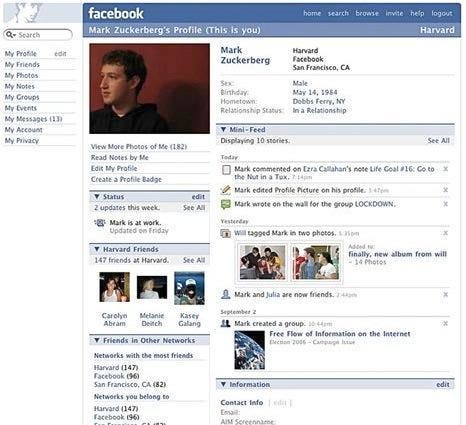
Clean. Uniform. Blue.
Everyone’s profile looked exactly the same. Blue and white. A profile picture in this specific spot. Your posts in this specific format. No customization. No personality beyond what you wrote and which photos you chose.
The shift happened fast because Facebook capitalized rapidly on the social graph and built the world’s most powerful planet-wide psychological experimentation and optimization platform to help it maximize retention.
Creativity today is federated through a few key platforms that exist fundamentally for one purpose: to maximize the time you spend on them.
For the last 15-20 years or so, we’ve been collectively psycho-optimized for maximum time-on-site by these services.
But here’s the thing: while the platforms were pulling everyone in, real web development was getting exponentially harder.
React. TypeScript. Build tools. Deployment pipelines. CI/CD. Webpack configurations. Node modules that take up gigabytes. Framework churn every six months.
The barrier to entry for building a personal website got higher while the platforms made it lower to just consume.
The 15-year-old who made a Flash game on Newgrounds in 2004? In 2020, they’d need to learn modern JavaScript, understand component architecture, figure out hosting, set up a build process, and probably learn Git just to put up a simple personal site.
Or they could just post on Instagram.
#
The weird internet returns
But something’s changing now.
AI tools are bringing back WYSIWYG in a new but familiar way.
Anyone can open Claude Code and say: “I want to make a website for my photography portfolio. Here’s the photos.”
And it gets built.
“Put the photos in a grid.”
Done.
“Make it work on a phone.”
Done.
The resulting code, like the WYSIWYG tools of yesteryear, might be garbage. But that’s not even close to the point.
The point is that anyone can do this now.
This is the parallel to the teenage years of the internet. Flash let non-coders create animations and games by giving them a visual timeline and drag-and-drop tools. AI tools are similarly enabling non-coders to make things simply by discussing the idea.
The barrier to entry is lower than it’s ever been.
You don’t need to know HTML, CSS, JavaScript, Git, or anything about deployment. You don’t need to understand frameworks or build tools. You just need to be able to describe what you want.
Like the WYSIWYG era of Frontpage and Flash, the focus is moving to “what do I want to make?” instead of “how do I build this?”, and this opens the doors to a lot more types of people making a lot more types of things.
And hell yeah am I excited to see what we all create.
No newer posts